










Renewable methanol production for the shipping industry
Delivering an adaptable, renewable and environmentally-friendly solution for marine transportation
Today, marine transportation is primarly driven by diesel engines
0
%
Of total EU GHG emissions are represented by shipping
0
%
Of the transport sector EU GHG emissions are represented by shipping
Methanol can play a key role in decreasing GHG emissions in global shipping
Switching from conventional fossil-based maritime fuels to methanol based on current technologies will already decrease GHG emissions significantly, with up to 70% of savings.
M²ARE aims at producing a new grade of low-cost and low-carbon methanol, based on biogenic CO₂ and renewable H₂
The overall ambition is to deliver a TRL-7 European methanol synthesis process by 2027, to support the needs of the global shipping sector in reducing its CO₂ emissions.
Concept overview
The work of M²ARE will lead to
Reduction of
CO₂ emissions by 2030
0
%
CO₂ emissions by 2040
0
%
Support for reaching maritime methanol production targets
MTa by 2030
0
MTa by 2040
0
MTa by 2050
0
Contribution to
Sustainable Development Goals
0
EU Regulation: FuelEU Maritime Regulation
0
News

Marine regulations towards a sustainable shipping fuel production
May 28, 2026
1. M²ARE: Driving Compliance and Innovation within the European Regulatory Framework The M²ARE project is a concrete response to the challenge of reducing Greenhouse Gas
M2ARE webinar report June 19th, 2026
May 25, 2026
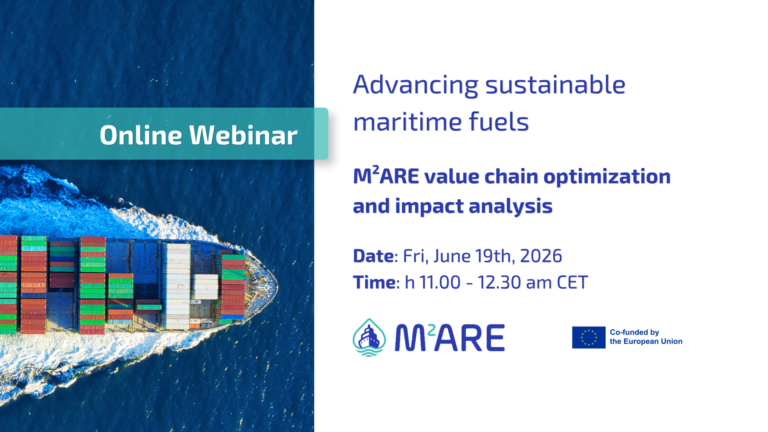
The M2ARE project recently hosted its online event, “Advancing Sustainable Maritime Fuels: M²ARE Value Chain Optimization and Impact Analysis” exploring how low-carbon methanol can drastically

M2ARE and COCPIT joint workshop at 34th EUBCE in The Hague (featuring SEAFAIRER, POSEIDON and NextFuel projects)
April 24, 2026
The recent joint workshop “Decarbonizing the Seas” brought together key stakeholders from European research to discuss technological innovations in the sustainable marine fuels sector, highlighting